Wu Dawang
Serve the People!Wu Dawang is a soldier whose pursuit of recognition and promotion is shaped by an early promise to move his wife, Zhao Ezi, from their village to the city. Selected as the Division Commander’s orderly after distinguishing himself in logistics and political study, he becomes entangled with the Commander’s wife, Liu Lian. His rise and departure unfold alongside the Division’s dissolution: the army publicly celebrates him as an exemplary servant of the people while arranging a privileged civilian future for him, and the affair that helped change his prospects remains hidden. Fifteen years later, he returns to Liu Lian’s compound, carrying the sign that once gave their relationship its private meaning.
Identity and Background
Before joining the army, Wu Dawang was a farmer from Wujiagou, a remote, drought-stricken village in western Henan. His father had died when he was young, leaving Wu Dawang and his widowed mother in difficult circumstances. His mother kept him in school until he was sixteen, and that education led to work as accountant for the village production team. At twenty-two, he entered the army with little experience of life beyond the village and a powerful desire to improve his standing.
His ambition is not simply a matter of personal advancement. It is tied to a specific promise made in the circumstances of his marriage to Zhao Ezi. Before they married, Wu Dawang pledged in writing that he would earn commendations within a year, join the Party within two, and become an official within three. He promised to get Zhao Ezi a city home where she could eat steamed rolls every day; if he failed, he swore not to return to Wujiagou unless she permitted it, and promised to serve her for the rest of his life. They married soon after the pledge was written. Two weeks later, his mother died, and his life became increasingly governed by the obligation he had accepted.
Ambition and Military Career
Wu Dawang makes his way through the army by work, political fluency, and an exceptional capacity to perform what is expected of him. When he returns to military service after his marriage, effort alone does not initially secure the commendation or Party membership he needs. Letters from Zhao Ezi and her father asking how he is progressing intensify his anxiety. He becomes so despairing when his name again fails to appear on the lists that he contemplates suicide.
His opportunity comes when a position opens as Sergeant of the Catering Squad. The work is exhausting and unpleasant, but it is known as a route to advancement, and eight soldiers compete for the single vacancy. Wu Dawang wins notice by serving the Political Instructor’s family with extraordinary deference, including entertaining the Instructor’s son by carrying him on his back. The episode reveals how readily he accepts humiliation when he sees a chance of promotion. He is transferred first as Deputy Sergeant, responsible for the company’s food and water, then becomes a full Sergeant and joins the Party. With the Political Instructor’s help, commendations and awards follow. The official’s four-pocket jacket remains out of reach, however, blocked in turn by a high blood-pressure reading, limited promotion quotas, and bureaucratic happenstance.
His performance at a Mass Theory and Practice of Frontline Logistics Competition brings him to the Division Commander’s attention. Wu Dawang recites 286 quotations and three essays by Mao Zedong word-perfect, then prepares a four-dish meal and soup within thirty minutes. Already repeatedly named a Model Soldier, he is appointed the Commander’s full-time orderly and cook. In this role he handles the household’s meals and encounters the “Serve the People!” sign that frames the novel’s political and personal conflicts. Its red lettering and revolutionary emblems—stars, rifle, canteen, and wheat—represent both the history of struggle and a promised future. Wu Dawang understands the symbol’s official meaning with particular thoroughness, even as its domestic setting will acquire a more intimate meaning for him.
Liu Lian and the Sign
Wu Dawang initially knows almost nothing about Liu Lian’s past or daily life. A nurse by training, she has not worked in a hospital since marrying the Division Commander and has spent five years at home. As the Commander’s orderly, Wu Dawang sees her chiefly through the routines of the household. His own attention is fixed on advancement; the appointment seems to bring him closer to the promotion needed to fulfill his pledge to Zhao Ezi.
Liu Lian’s approach unsettles that calculation. After Wu Dawang initially rejects her advance, she tells him that she has instructed his Political Instructor to arrange his discharge at the end of the year so that he can return to his wife. Her response makes clear how consequential he believes the rejection to be: he fears losing both his place in the household and the future he has been pursuing. He later returns to Liu Lian, and the relationship becomes an affair. She understands his desire to bring Zhao Ezi to the city and says she will help arrange matters for his family when promotions resume. This promise places Wu Dawang’s private attachment beside the original bargain that brought him into the army: his future continues to depend on favors and prospects beyond his control.
The sign becomes a shared signal within the household. When Liu Lian points to it in the kitchen, she means to remind Wu Dawang of his official role and position. He understands it through the private meaning the two have developed, as a call to serve her in a different sense. The mismatch between the public slogan and their private code illuminates the relationship’s unequal setting: a political emblem that orders service in the Commander’s home can be repurposed within that home as a sign between the orderly and the Commander’s wife. Later, as their relationship changes and the Division is dismantled, the sign will become a keepsake of a life that cannot be resumed.
Restructuring, Departure, and Recognition
While Wu Dawang is away on furlough in western Henan, the Political Instructor tells him that the Division Commander has volunteered at a seminar in Beijing to test a pilot plan for streamlining and restructuring the army. The practical consequence is the dissolution of the Division. Most companies are to be demobilized and the rest transferred, so promotions are cancelled. The career path on which Wu Dawang has staked his future appears blocked once more. Yet the Commander has ordered an exception for him: a city job in his home province, housing for his family, and work for Zhao Ezi. Liu Lian has personally explained his absence as the result of serious family problems and secured an extended leave. Wu Dawang is relieved to learn that the affair has not been exposed, and he initially interprets his favorable arrangements as the payoff for the relationship.
The homecoming that follows is not a straightforward reunion. The Political Instructor warns Wu Dawang not to return to the Commander’s house, where a succession of orderlies have angered the Commander amid the instability of restructuring. When Wu Dawang seeks further information, he glimpses a group of officers drinking together: the Battalion Commander, his own Captain, and other men whose common connection is having served the Division Commander earlier in his career. The Captain warns him to say nothing about what he has seen. The encounter leaves Wu Dawang uncertain, while the larger dismantling of the Division proceeds around him.
At first, the effects of the restructuring seem to favor Wu Dawang. Within a week of his return, work and housing have been arranged for his family in the nearest city. He need only sign the forms. But as he watches comrades face transfers and demobilization, his thoughts begin to join the upheaval to his affair. He suspects that the relationship may have been part of a scheme choreographed behind the scenes, with his freedom limited to whether he emotionally committed to the role. The Head of Management sharpens that suspicion when he tells Wu Dawang that he has come out better than the others thanks to Liu Lian. Wu Dawang cannot settle the question: he resists believing the Division Commander would exploit the restructuring for personal ends, yet his own benefits stand in stark contrast to the distress and uncertainty of his comrades.
His departure is both hurried and ceremonially honored. After formal notification of his demobilization, Wu Dawang learns that he has been assigned a job at the East is Red Tractor Factory, and must report almost immediately. The Division supplies boxes and crates for his belongings; his company holds a farewell supper and meeting. The Head of Management announces a Third Order of Merit and publicly presents him as an outstanding revolutionary thinker and exemplary servant of the people, saying that the state-allocated job follows from his service. The ceremony turns his private and irregular route to a city future into a public lesson in political virtue. Wu Dawang says nothing when asked to address the company; he accepts the distinction with a bow and salutes the officers on stage.
His comrades gather to shake his hand and wish him well, treating him as an example of service. When the jeep arrives to take him to the station, he has nothing to say to their praise. He has tried not to cry, but his tears come as the vehicle starts away. The scene’s official language of achievement cannot erase the loss of the army world he is leaving, even as his privileged assignment separates him from those who face less certain futures.
The Last Meeting and Return
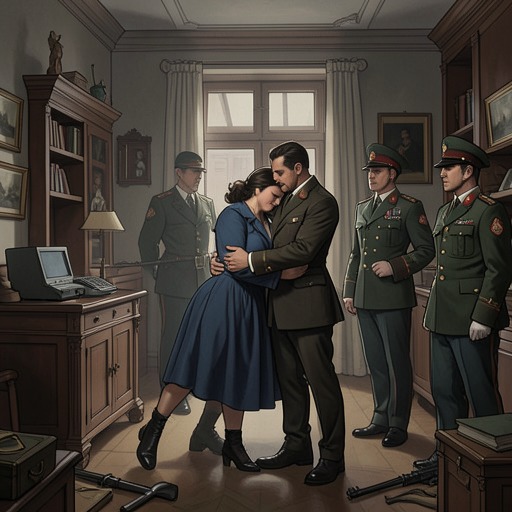
Before leaving, Wu Dawang accompanies the Political Instructor to see Liu Lian. The Instructor has asked for her help in persuading the Division Commander to keep him in the army, explaining that he too had married on the strength of a promise that military service would bring his wife a city job. Wu Dawang is struck by the resemblance to his own marriage bargain. At Liu Lian’s door, he sees that she is visibly pregnant. She already knows he will leave on the 12:30 train. He tells her he wanted to see her once more and gives her pine kernels he brought from home.
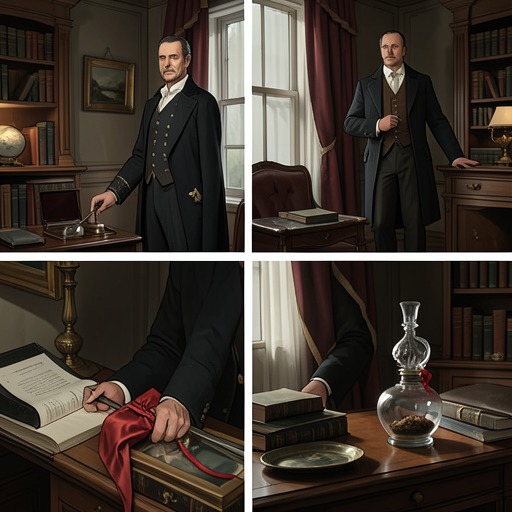
While Liu Lian is upstairs, Wu Dawang looks into the house where he once worked. A new framed print has replaced the quotation the lovers destroyed, and he wants to see whether the “Serve the People!” sign remains. Before he can explore further, Liu Lian returns and silently gives him a long, narrow object wrapped in red silk: the sign he had been thinking of asking her to give him. The return of the sign transforms it from a household emblem and private signal into a memento that Wu Dawang carries away. Three days later, the Division’s final demobilization is officially announced, scattering those who knew about the affair and those who did not. The secret disappears into the same institutional dispersal that ends his military life.
Fifteen years later, Wu Dawang returns to the compound in the provincial capital. Middle age has left him marked by a tired expression and a melancholy that the upheavals of his generation have deepened. He knows from newspapers and television that the former Division Commander has become Provincial Commander-in-Chief; his knowledge of Liu Lian comes only through fragments of gossip. Seeing a teenage boy skating on the frozen Jinshui River, Wu Dawang goes to the compound gate. He receives a brief note offering help with money or another need, then looks toward the front door and hands the sentry the red-silk-wrapped object, asking that it be given to Liu Lian. He turns and walks away into the snow. The novel leaves the contents and meaning of their final exchange unspoken: Wu Dawang has returned the sign, but not the years or the future once attached to it.